Other Guides
In this article
Python vs. Kotlin: Which is Best for You?
 Ekene Eze
Python and Kotlin are both at the top of modern programming languages, but they shine in different areas. Python leads in data science, automation, and backend systems. Kotlin has become the go-to choice for Android development and modern JVM-based applications.
So, which one should you pick for your next project? In this guide, I’ll break down what each language offers, how they compare, and which one is a better fit for you.
TL;DR: Python vs. Kotlin
Go for Python if...
You are building artificial intelligence (AI) or machine learning (ML) pipelines, data analysis tools, or automation scripts.
You want rapid prototyping with minimal boilerplate.
Your project relies on heavy data processing libraries.
You want a flexible language that adapts to scripting, backend services, experiments, and cloud tools.
You are targeting careers in data science, machine learning, or DevOps.
You value a massive ecosystem filled with pre-built libraries and frameworks.
Go for Kotlin if...
You are developing Android applications or targeting mobile platforms.
You need smooth Java interoperability and want to modernize Java Virtual Machine (JVM) codebases.
You prefer static typing with built-in null safety.
You are building server-side applications that benefit from strong type safety and clearer debugging.
You are aiming for Android development or backend roles in Java-focused organizations.
Before looking at both languages in detail and how they fit into your workflow, let’s compare their features.
Python vs. Kotlin: Comparison table
The table below summarizes the key features of Python and Kotlin:
Feature | Python | Kotlin |
Type system | Dynamic typing (optional type hints) | Static typing with full type inference |
Performance | Slower for compute-heavy tasks | Faster, closer to Java |
Main runtime | CPython | JVM (and Native via Kotlin Multiplatform) |
Learning curve | Very beginner-friendly | Moderate, especially for non-Java developers |
Ecosystem | Huge library ecosystem for data and AI | Strong mobile ecosystem, growing backend space |
Null safety | No built-in null safety | Built-in null safety at compile time |
Concurrency | Threading, asyncio, multiprocessing | Coroutines with structured concurrency |
Community | Massive global community | Fast-growing mobile focused community |
Paradigm | Multi-paradigm (procedural, OOP, functional) | Multi-paradigm (OOP, functional) |
With the key features laid out in the comparison table, the next step is to understand when each language truly shines. Choosing a language is not just about comparing features. It is about finding the right fit for your project, your career path, and your workflow. So let’s explore practical reasons why you might choose either Python or Kotlin based on your goals.
Why choose Python?
Python is one of the most versatile programming languages in tech and has long been the preferred choice for simple and complex tasks. It was created in 1991 and has evolved into a language that powers everything from small automation Python scripts to massive machine learning platforms used by companies like Spotify, Netflix, and Instagram.
The core philosophy of Python focuses on readability and simplicity. Python code reads almost like English, which means you spend less time figuring out syntax and more time solving real problems. This makes it perfect for prototyping, education, and projects where iteration speed is more important than raw performance.

Below are some of the reasons why you should choose Python:
Perfect for AI, ML, and data science
Python is the go-to language for modern AI work. If you want to build machine learning models, process large datasets, or experiment with the latest AI tools, Python gives you everything you need. Libraries like Pandas, NumPy, TensorFlow, and PyTorch handle the heavy lifting so you can focus on solving real problems.
Companies investing in AI and ML also hire Python developers because most research and production pipelines rely on Python. From Jupyter notebooks for exploration to production APIs that serve predictions, the Python workflow stays consistent across teams.
Automation and scripting excellence
If you ever think, “There has to be an easier way to do this,” Python often provides that easier way. It shines in automation and scripting. Whether you are processing files, scraping websites, or connecting APIs, Python offers standard libraries and third-party packages that make complex tasks simple to automate.
DevOps engineers and system administrators rely heavily on Python to build automation tools and write reliable maintenance scripts. Tools like Ansible are built with Python, which makes the language a natural fit for infrastructure work.
Massive ecosystem and community
One of Python’s biggest strengths is its ecosystem. You never feel like you are working alone. There are libraries and frameworks for almost every idea you can imagine, supported by a huge global community. Tutorials, open source projects, tools, frameworks, and active discussions make Python a great choice for beginners and experienced developers.
If you get stuck, chances are someone has already solved the problem and shared the solution.
Broad career paths
Choosing Python does not lock you into one niche. It actually opens more doors. Python gives you the flexibility to move into data science, web development, automation engineering, cybersecurity, DevOps, AI research, or even game development. It is a language that grows with you and allows you to shift into new industries without starting over. That level of flexibility is a major career advantage.
Beyond the points above, Python also has many practical use cases across different industries. For example:
Netflix uses Python for their content recommendation engine, data pipelines and analysis, and automation.
Spotify relies on Python for data analysis, backend services, recommendation algorithms, and infrastructure tasks
Instagram built its backend with Python and Django to support millions of users and massive volumes of content.
Why choose Kotlin?
Kotlin is a modern programming language that brings fresh, powerful features to the JVM. It is the officially recommended language for Android development and a top choice for teams updating old Java projects or building new cross-platform applications.
Kotlin includes null safety, coroutines, extension functions, and data classes. These features remove entire categories of bugs and reduce the boilerplate that often appears in Java. The result is a smoother and more enjoyable development experience compared to many other JVM languages.
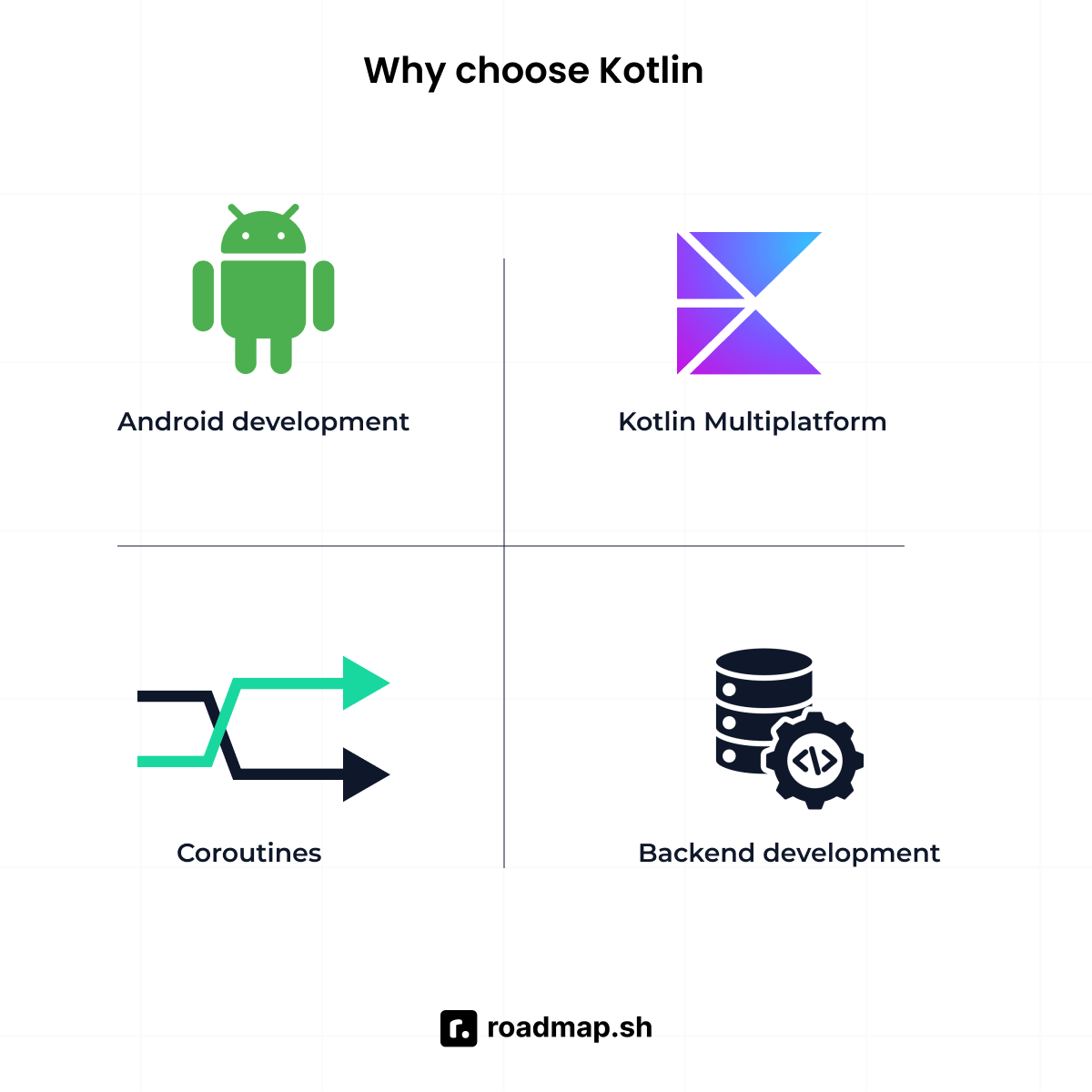
Below are some of the reasons why you should choose Kotlin:
Best-in-class Android development
If you are building Android applications today, Kotlin is the language to use. Google officially recommends it, and most modern Android tools, including Jetpack Compose, are designed with Kotlin in mind. Features like extension functions, data classes, and null safety simplify everyday tasks, reduce boilerplate, and help you build polished apps faster.
Kotlin multiplatform
One of Kotlin’s biggest strengths is Kotlin Multiplatform. It allows you to share core business logic across Android, iOS, desktop, web, and even backend services. Each platform still uses its own native UI, but you avoid duplicating logic across multiple codebases. This leads to fewer inconsistencies, quicker development cycles, and easier long-term maintenance. If your team wants to target several platforms without relying on heavy cross-platform frameworks, Kotlin Multiplatform is a great choice.
Strong static typing for robust apps
Kotlin gives you the productivity of a modern language with the reliability of strong static typing. The compiler catches many errors before your code runs, leading to more stable apps and fewer edge case crashes. You get predictable behavior without losing flexibility.
In addition, features like null safety, sealed classes, and smart casting encourage you to write safe, efficient code that is easy to maintain and organize.
Smooth Java interoperability
Kotlin integrates seamlessly with Java. You can call Java code from Kotlin, call Kotlin code from Java, and use existing Java libraries without trouble. This makes Kotlin practical for gradual adoption in large Java codebases because you do not need to rewrite everything at once. The Spring framework, a Java-based framework, supports Kotlin very well, allowing you to build backend services with modern syntax on top of dependable Java infrastructure.
Coroutines for concurrency
Asynchronous programming can get complicated quickly, but Kotlin’s coroutines keep it manageable. Instead of dealing with callback chains or complex threading, coroutines let you write asynchronous code that looks like regular sequential code. This makes tasks such as network requests, database operations, and background processing smooth, predictable, and easier to reason about.
Beyond the points above, Kotlin also has many practical use cases across different industries. For example:
Corda, a blockchain / distributed ledger platform, is written largely in Kotlin, showing that Kotlin is not just for mobile.
Pinterest migrated its Android app to Kotlin and saw improvements in stability and developer productivity.
Google recommends Kotlin for Android and also uses it internally for server-side JVM development.
JetBrains, the creator of Kotlin, uses Kotlin to share logic across its Android, iOS, and web applications.
We have covered why you might choose Python or Kotlin. The next step is to put them head-to-head and look at the major differences that can influence your final decision.
Kotlin vs. Python: Key differences
Below are the key points to keep in mind when comparing Kotlin and Python for your next project:
Typing system and developer experience
Python is dynamically typed. You can write code quickly, make changes on the fly, and let the interpreter figure out data types at runtime. This is great for beginners and rapid prototyping, but it can lead to errors that only appear when the program runs.
Kotlin is a statically typed language. The compiler checks types at build time, so you catch many mistakes early in development. This leads to more reliable code, especially as your project grows. Features like null safety, sealed classes, and smart casting give you more confidence in your code without slowing you down.
Tooling and debugging
Python has solid tooling, especially in the data science space. Tools like Jupyter Notebook, VS Code, PyCharm, and countless libraries make it easy to explore data, build web apps, test ideas, and visualize results. Debugging is simple, but sometimes limited because the language is dynamic.
Kotlin benefits from the full power of IntelliJ IDEA, Android Studio, and the broader JVM ecosystem. The tooling is extremely polished. You get smart autocompletion, strong refactoring tools, real-time error detection, and powerful debuggers. This level of support makes a big difference in large codebases or long-term projects.
Kotlin vs. Python Performance
Python and Kotlin behave very differently under the hood. Python is an interpreted language, which makes it flexible and great for quick experimentation. That flexibility comes with a tradeoff because interpreted code usually runs slower. This is perfectly acceptable for data science, automation, and prototyping, particularly when your work is not centered on very heavy CPU tasks.
However, Python’s performance limitations are often overstated. Libraries such as Pandas and optimized frameworks like FastAPI handle intense data processing surprisingly well because the heavy computation happens in highly optimized lower-level code.
Kotlin, on the other hand, is compiled to JVM bytecode or native code. This typically results in much faster performance. It is a strong choice for Android app development, server-side services, and anything that needs consistency.
Learning curve and getting started
Python is widely considered the most beginner-friendly language. The syntax reads almost like English, the community is welcoming, and you can write useful scripts within a few hours of learning it. This simplicity is one reason it is often the first language taught in universities and coding boot camps.
Kotlin has a slightly steeper learning curve. It introduces concepts like static typing, coroutines, and generics early on. Once you get familiar with these ideas, Kotlin becomes very enjoyable because of its clean and expressive syntax. Compared to Python, you need more programming fundamentals, but Kotlin is relatively easy to pick up if you already know an object-oriented language like Java.
Ecosystem maturity
Python has been around since the early 1990s and has one of the largest ecosystems in software development. It is one of the most popular programming languages that is loaded with libraries and frameworks that support data science, machine learning, web development, scripting, automation, DevOps, and game development. If you can imagine something, there is probably a Python library for it.
Kotlin’s ecosystem is younger, but it is growing quickly. It excels in Android development, JVM-based services, and multiplatform projects. It can also leverage Java's existing ecosystem to build robust and scalable applications.
Now that we have broken down the key differences between Python and Kotlin, let’s bring it all together and answer the big question: Which language should you learn?
Which language should you learn?
Deciding which language to learn can feel overwhelming because both options offer strong advantages. The best approach is to think about your long-term interests, your preferred workflow, and the types of applications you want to create. Let’s look at these points in detail.
Project requirement
Start by considering the type of projects you want to build or what excites you the most. If you are working on ML, AI, or data analytics tasks that involve building data visualization dashboards, running database queries, processing CSV files, or transforming data pipelines, Python is the clear winner. Major libraries and frameworks like TensorFlow, PyTorch, Pandas, NumPy, and scikit learn make these tasks simple.
If you want to build Android apps or explore multiplatform development with shared logic for iOS, desktop, and web, Kotlin is the right choice. Google recommends Kotlin for Android development, and many modern apps like Pinterest, Trello, and Slack use it in production.
Ecosystem
Ecosystem maturity, size, and open source adoption matter more than most beginners realize. You will rely heavily on libraries, frameworks, and community support as your projects grow.
Python has one of the largest ecosystems in tech. Whether you need web frameworks like Django or FastAPI, scientific tools for ML, automation utilities, or integrations with cloud platforms, Python has options for almost every kind of project.
Kotlin’s ecosystem is smaller but very modern and growing rapidly. It excels on the JVM and Android, and it is expanding into the cross-platform and backend space. Because Kotlin works seamlessly with Java, you can tap into Java’s massive ecosystem while writing clean and modern Kotlin code. This makes it great for mobile and backend apps.
Project complexity
The level of complexity in your project also plays a major role in choosing a language.
Python is excellent for quick prototypes, internal tools, automation scripts, and research projects. Its dynamic nature allows you to experiment quickly and iterate without friction. This is why developers and data scientists rely on Python when they want to test ideas or automate repetitive workflows.
Kotlin is better for large applications and external tools that require strong type safety and high performance. The static typing system catches bugs early, the compiler is strict in a helpful way, and coroutines make concurrency easier to manage. These strengths become important when building long-term mobile apps or backend systems that need to scale reliably.
Career path
Your career goals should play a major part in your decision.
Python gives you flexibility. You can move into data science, machine learning, backend development, web development, DevOps, automation engineering, or research computing. It is often recommended for beginners because it opens the widest range of opportunities.
Kotlin prepares you for a more focused but highly in-demand path as a modern programming language. If you want to build Android apps, work on JVM-based systems, or explore multiplatform development, Kotlin gives you skills that many companies actively look for. It is especially valuable if you want a modern language with strong engineering practices.
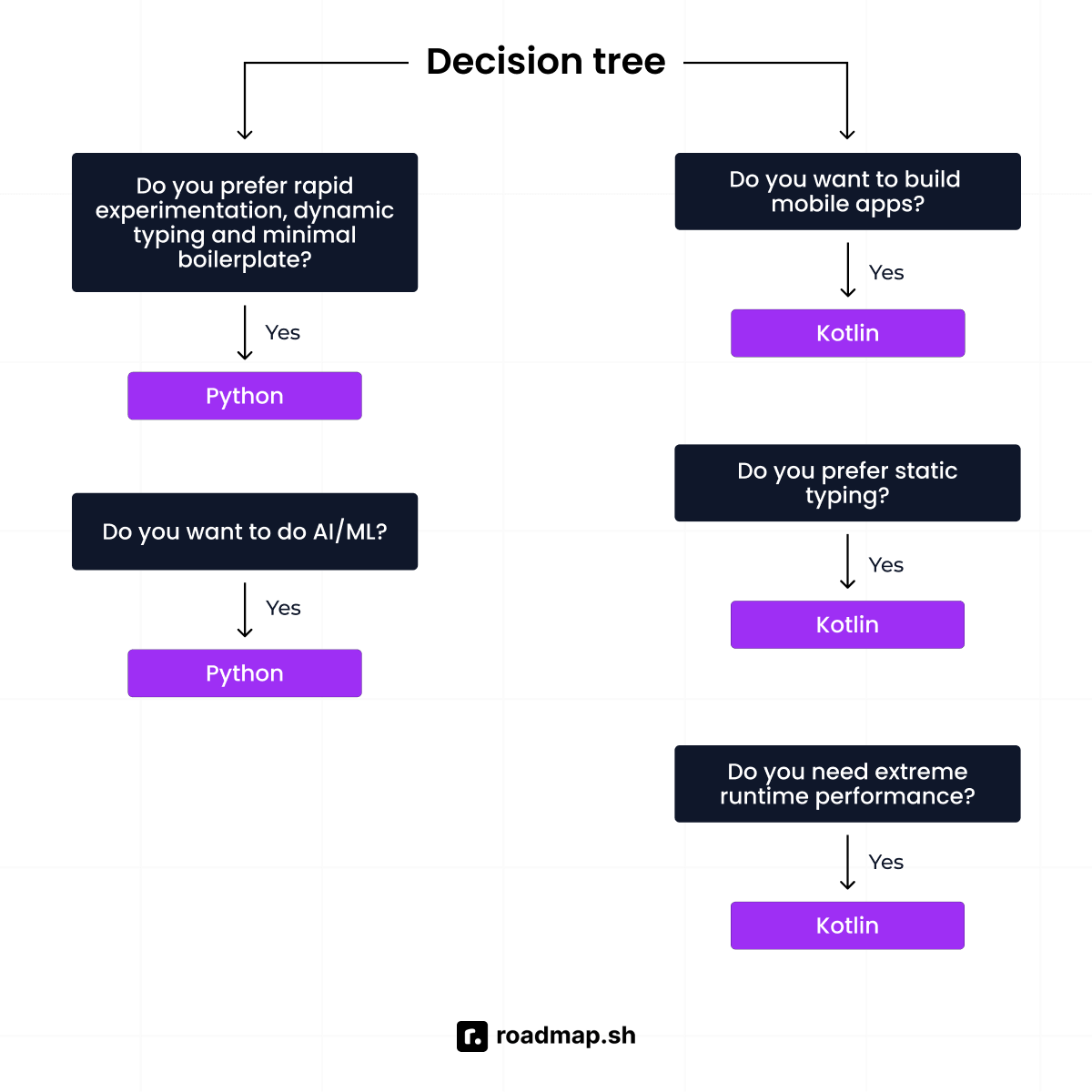
As a rule of thumb, use this decision framework to decide which language best fits your goals:
Decision factor | Choose Python if | Choose Kotlin if |
Project requirements | You are building ML models, AI tools, data pipelines, automation scripts, or quick backend APIs. | You are building Android apps, JVM services, or Kotlin Multiplatform projects with shared logic across operating systems and platforms. |
Performance needs | You do not need extreme runtime performance and rely on optimized libraries for heavy computation. | You want fast and predictable performance for production apps or backend systems. |
Development style | You prefer rapid experimentation, dynamic typing, and minimal boilerplate. | You prefer strong type safety, compile-time checks, and structured code that scales well in large applications. |
Ecosystem maturity | You need access to large libraries for ML, data science, automation, scientific computing, or DevOps. | You want modern tools like Android Studio, Jetpack Compose, Ktor, and a growing multiplatform ecosystem. |
Career goals | You want flexibility in fields like ML, data science, backend engineering, automation, or DevOps. | You want to specialize in Android, JVM engineering, or cross-platform app development. |
Learning curve | You want a beginner-friendly language that offers quick wins. | You are comfortable with a slightly steeper learning curve and want clean, maintainable code in the long term. |
Wrapping up
Python and Kotlin are powerful in their own ways. Python thrives in data-heavy and AI-driven projects, and it is a strong choice if you want flexibility as you build. Kotlin shines in Android development, JVM workloads, and modern app engineering. It is ideal if you prefer clean code, solid performance, and mobile-first projects.
Ultimately, think about where you want your career to be in five years. Do you want to specialize in a domain like mobile development? Or do you want the freedom to move between data, backend, and automation roles? Kotlin development points you toward focused expertise. Python gives you wider opportunities but still pushes you to choose a specialization as you advance.
If you want to go deeper, check out the Python roadmap and Kotlin roadmap for structured learning paths. If you want hands-on support while learning, try the AI tutor for real-time help with concepts, code reviews, and project guidance tailored to your style.