In this article
C# vs C++: Which is Best for You in 2026?
 Ekene Eze
If you have ever stared at a project and wondered whether to write it in C++ or C, you are definitely not alone. C is still the top choice for bare-metal programming and system-level work, giving you tight control over hardware. C++ builds on that foundation and adds modern abstractions and object-oriented tools that help you design and maintain complex software with less friction. Picking the right language can affect how your project performs, how it scales, and how many headaches you avoid along the way.
In this guide, I will break down what each language offers, how they compare, and which one fits your goals.
TL;DR: C vs. C++
Choose C++ if...
You are building complex systems or performance-heavy applications.
You want speed along with modern abstractions like classes, templates, and Resource Acquisition Is Initialization (RAII).
You are working on game engines, large enterprise applications, real-time simulations, or advanced backend services.
You want to grow within the broader C++ ecosystem, which has an active roadmap with evolving standards.
Choose C if...
You want to write C programs that require tight control over hardware, such as embedded systems, microcontrollers, or firmware.
Your project needs strict predictability with very little overhead.
You are developing kernel-level code or operating system components.
You want maximum portability across platforms with minimal dependencies.
You are maintaining legacy codebases that are already written in C.
Before looking at both languages in detail and how they fit into your workflow, let’s compare their features side by side.
C++ vs. C: Comparison table
The table below summarizes the key features of C++ and C, including how they handle source code in different contexts:
Feature | C++ | C |
Programming model | Multi-paradigm, including OOP and generic programming | Procedural |
Abstractions | Rich and modern | Minimal |
Memory management | Manual plus RAII and smart pointers | Manual |
Performance | High performance with more abstraction options | Predictable, minimal overhead |
Concurrency | Standard library concurrency features | Pthreads or platform APIs |
Ecosystem and resources | Large, active, and tied to modern standards | Lean, stable, very low-level language |
Binary size | Larger, especially when using STL and exceptions | Smaller |
Learning curve | Steeper due to feature richness | Gentler for low-level concepts |
The table gives a quick snapshot, but the real choice between C++ and C depends on the kind of problem you want to solve. Both languages have clear strengths and limitations, so let’s explore why you might choose one over the other.
Why choose C++?
C++ is designed for situations where complexity grows quickly and you need tools that help you stay in control. Its abstractions, strong type system, and object oriented features help you scale software without turning the codebase into a maze. If your project needs structure, flexibility, or high performance while still staying maintainable, C++ is the better pick.
Since its release, C++ has continued to evolve with a steady roadmap that introduces features that help you write safer and faster code without giving up control.
Below are some of the reasons why you should choose C++:
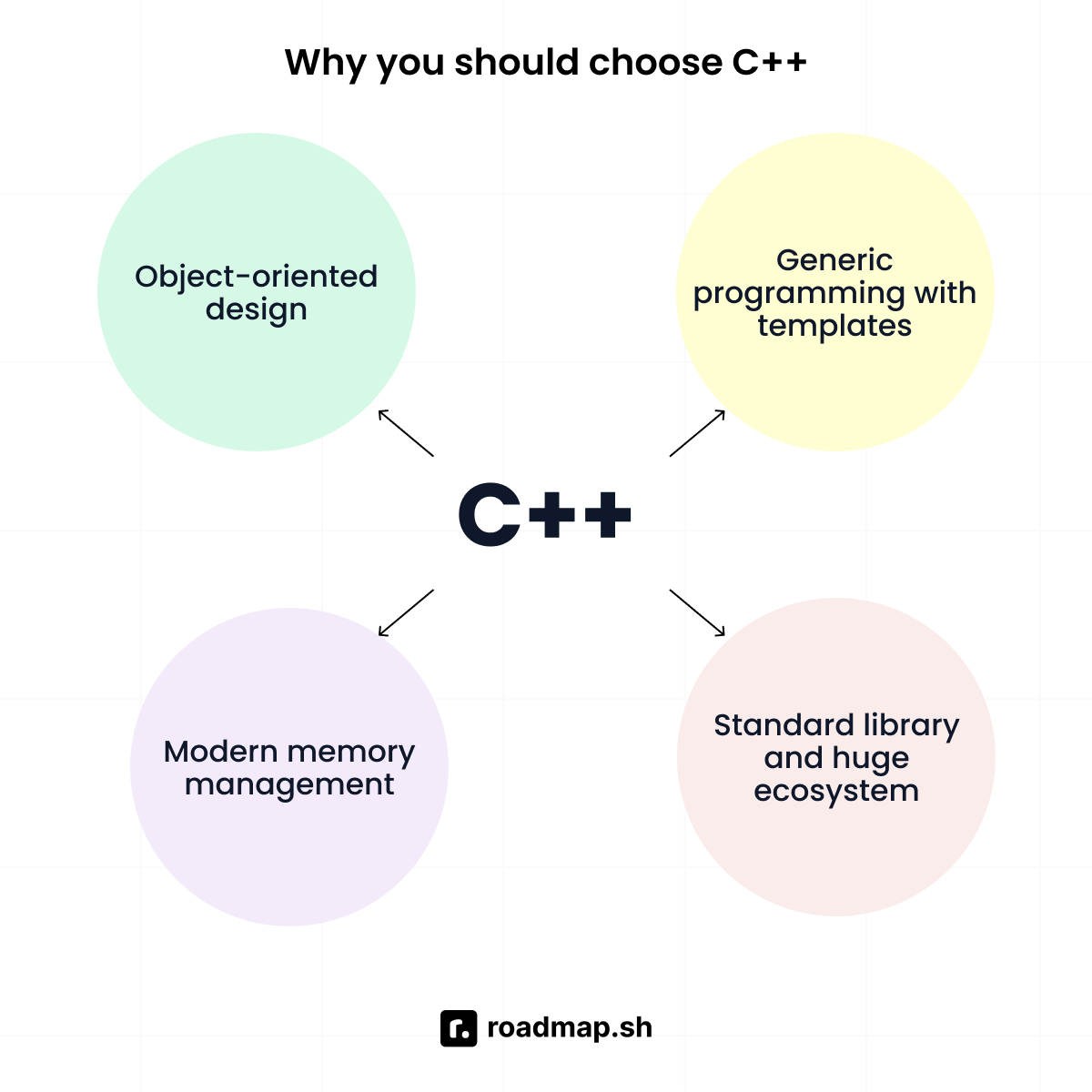
Object-oriented design
Once your codebase grows beyond a few hundred lines, organization becomes critical. C++ gives you a solid and flexible approach that support object oriented programming. It supports classes, polymorphism, inheritance, and encapsulation, which let you model real-world systems with clear structure and reusable components.
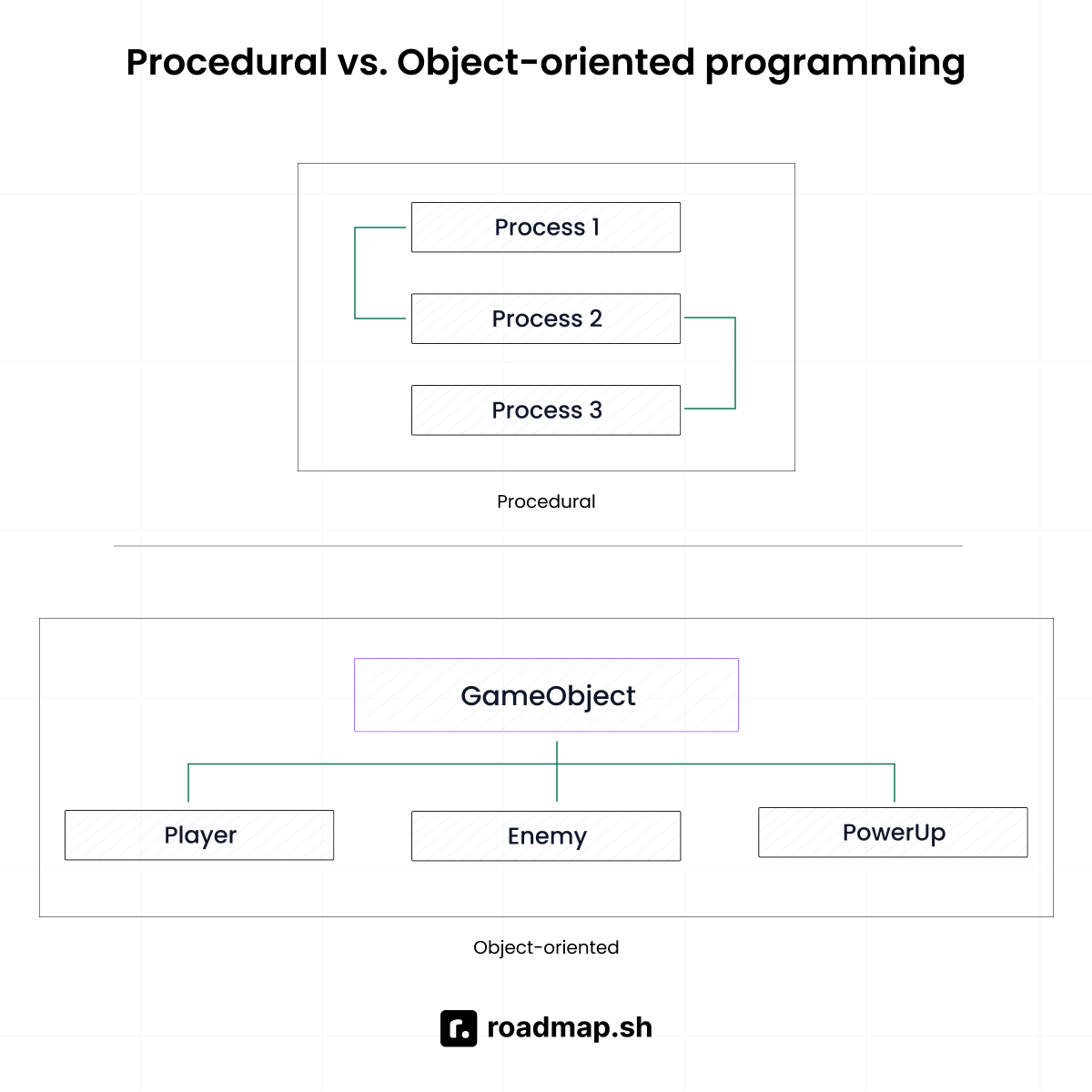
If you are building something large, such as a game or business application with many interacting parts, OOP helps keep everything manageable. For example, in a game engine you might create a base GameObject class, then derive classes like Player, Enemy, and PowerUp. Each one can define its own behavior while still sharing the same core interface.
This balance of structure and flexibility is one reason why industries like robotics, finance, desktop applications, and game development rely heavily on C++.
Generic programming with templates
Templates are one of the most powerful features in C++, and they can be integrated with function pointers for flexible callback systems. They let you write code that works with any data type while staying fully type safe. This reduces repetition and keeps your code efficient because templates are resolved at compile time.
A good example is the standard template library (STL). Containers like vector, map, and unordered_set work with any data type while maintaining both type safety and performance. You can also create your own template functions or classes for reusable algorithms, networking utilities, or custom data structures.
Modern memory management
Older C++ required very manual memory handling, but modern C++ has improved a lot. Smart pointers such as std::unique_ptr, std::shared_ptr, and std::weak_ptr let you manage memory safely with minimal overhead. They automatically release resources when they are no longer needed, which helps prevent memory leaks and dangling pointers.
This approach is especially helpful for software that runs continuously or handles many transactions, such as backend services or real-time game engine loops.
Modern C++ also uses RAII, which automatically cleans up resources when an object goes out of scope. You still keep the low-level control that C++ is known for, but with much better safety.
Standard library and matured ecosystem
The C++ standard library offers a wide range of tools for everyday development. You get containers, algorithms, threading utilities, file handling, smart pointers, random number generation, and more. These features are well-tested across platforms, which means you do not need to reinvent every piece of functionality.
Outside the standard library, the C++ ecosystem is broad and reliable. There are frameworks for nearly every domain, including:
Qt for cross-platform GUI applications
gRPC and REST SDKs for networked services
CUDA for high performance GPU computing
Boost for advanced utilities and extensions
The community is large, the tooling is mature, and support for debugging, profiling, and building complex systems continues to improve.
Beyond the points above, C++ also has many practical use cases across different industries. For example:
Unreal Engine and Unity are built with C++ because of the language’s speed, low-level memory control, and suitability for high-performance real-time systems like rendering and physics.
Chrome, Firefox, and other web browsers use C++ for performance-critical components.
High-frequency trading platforms use C++ to meet strict microsecond-level latency requirements.
Why choose C?
The C programming language might be one of the oldest languages in modern software development, but it has not faded into the background. Instead, it has become the foundation for many of the tools and systems we rely on every day. It shines when you want full control over what happens under the hood by keeping things simple, predictable, and close to the hardware. This makes it an ideal choice for embedded systems, kernels, and performance-critical code. If you prefer minimal overhead and tight control, C is a more reliable option.
The language is simple enough to learn quickly but powerful enough to build entire operating systems. Its minimalism is a feature rather than a limitation. Every line of C code maps closely to assembly, which is valuable when you need to know exactly what the CPU is doing.
Below are some of the reasons why you should choose C:
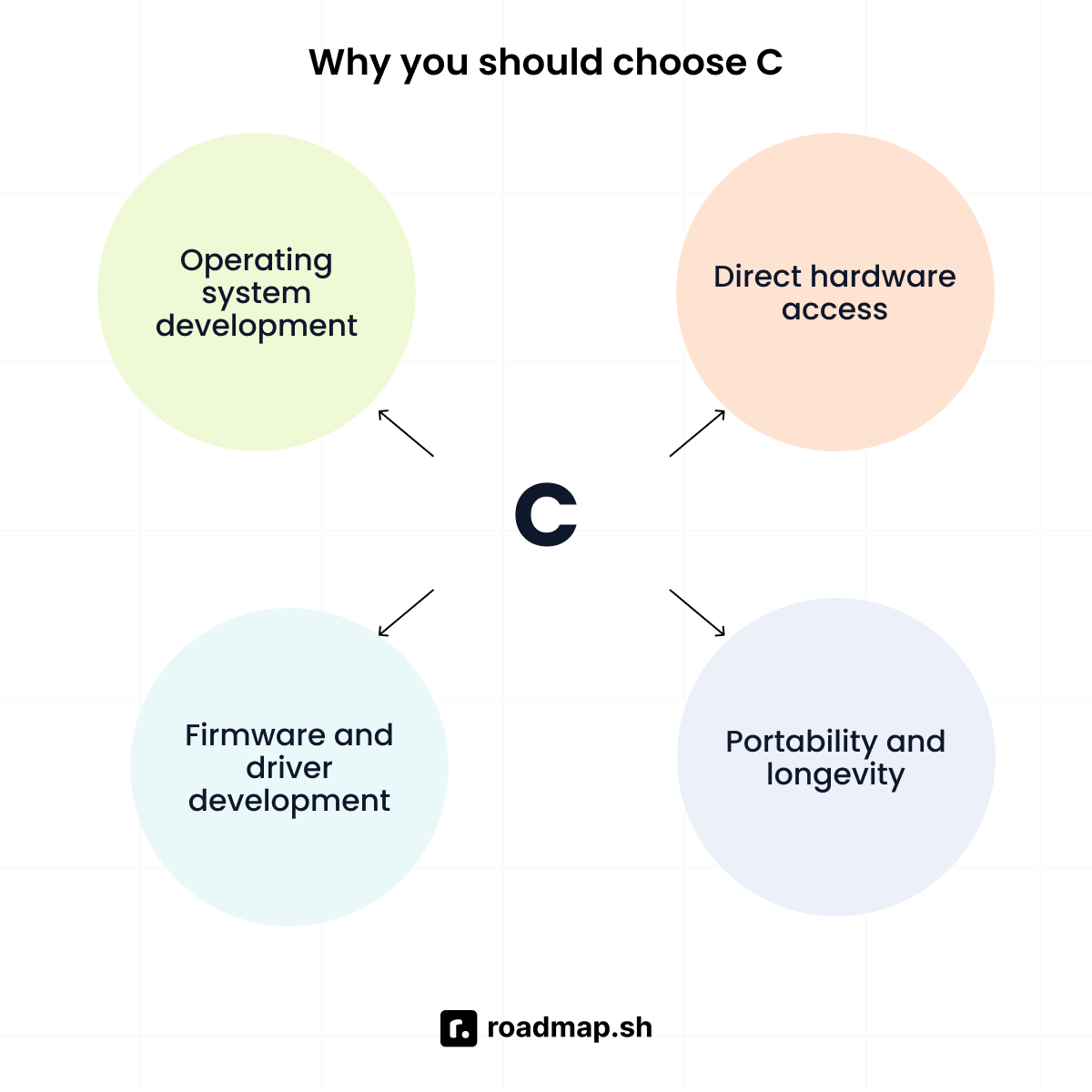
Operating system development
The C language sits at the core of almost every popular operating system you use in your day-to-day activities. Linux, macOS, Windows operating systems, and countless embedded operating systems are built primarily with C. The language gives developers tight control over memory, data layout, and execution flow. This level of control is essential when you are building components like kernels, schedulers, file systems, or process managers.
For example, when Linus Torvalds, the creator of the Linux OS, talks about why Linux is not written in C++, he often highlights C’s simplicity, predictability, and directness. Predictability is crucial here because parts of the kernel must react to events within microseconds, something higher-level languages like C++ do not always offer.
Direct hardware access
One of C's biggest advantages is its ability to work directly with hardware. Through pointers, memory-mapped I/O, and explicit control over data types, C lets you operate at the same level as the machine itself. This is essential when you need to toggle GPIO pins on a microcontroller, read sensor data, or manage communication protocols such as SPI, I2C, or UART.
A classic example is writing to a specific memory address that controls an LED on a development board. With C, you can map that address and set its value to turn the LED on or off. This kind of direct control is difficult, or sometimes impossible, in higher-level languages that hide hardware details behind abstractions.
Firmware and driver development
When you build firmware for embedded devices or write drivers for specialized hardware, you need a language that is predictable and lightweight. C fits this role perfectly. It produces small binaries, has no hidden runtime behavior, and gives you deterministic control over timing and memory.
This is why firmware for smart appliances, routers, industrial sensors, and medical equipment is often written in C. These systems depend on exact control over how data is read, written, and interpreted, so the low-level access that C provides is a perfect match.
Portability and longevity
C code written 25 years ago often compiles and runs today with very few modifications. This is because C was designed with portability in mind. The ANSI C standard (C89) is still widely used, and newer standards like C99, C11, C17, and C23 have added features carefully while keeping forward compatibility. In most cases, code written for an older standard still compiles cleanly with modern compilers.
This matters because the language changes slowly. If you invest in C for your project or embedded system, there is a strong chance it will continue running reliably far into the future.
Beyond the points above, C also has many practical use cases across different industries. For example:
Database software and engines such as SQLite, MySQL, and PostgreSQL rely heavily on C for query processing, indexing, and storage management.
Networking equipment and telecom systems, including switches, routers, and VoIP platforms, use C to meet strict performance and reliability requirements.
Hardware platforms like Arduino, STM32, ESP32, and many industrial control boards use C for firmware because it runs with very little overhead and fits well within limited memory.
Now that the strengths of each language are clear, it helps to look at the core differences that shape how they perform in practice. These distinctions make it easier to understand why one language fits certain projects better than the other.
C++ vs. C: Key differences
C++ and C share a common legacy, but they approach problem-solving in very different ways. These differences affect how you manage memory, structure programs, and scale your code as a project grows. Understanding these contrasts helps you see why each language excels in certain scenarios and struggles in others. Below are the key points that set them apart in day-to-day development.
Memory management philosophy
One of the biggest differences becomes clear as soon as you start working with memory. C gives you full manual memory management through functions like malloc, calloc, and free. This makes it a strong fit for systems programming and embedded development, but it also requires discipline. Forgetting to free memory or accidentally overwriting the wrong region can lead to tricky bugs.
C++ provides the same low-level control but adds safer and more modern options. Smart pointers such as std::unique_ptr and std::shared_ptr help automate cleanup. RAII releases resources when objects go out of scope. These tools reduce the chances of leaks and make resource handling easier.
Performance trade-offs
Both languages deliver high performance, but they approach it differently. C keeps its feature set small, with no runtime cost from classes, templates, or exceptions. In environments where memory is tight or timing is extremely strict, this minimal design can offer an advantage. Many firmware and kernel projects rely on this predictable and lightweight behavior.
C++ adds abstractions that help you write expressive and scalable code, although some of these features can introduce overhead if used carelessly. Heavy template metaprogramming or exception-heavy designs might increase binary size. The trade-off is that you gain tools that make complex projects much easier to structure.
Programming paradigm and design approach
C is a procedural language that focuses on functions, data structures, and clear control flow. This style works especially well when you want small, efficient, and predictable programs.
C++ supports a procedural programming language, too, but it goes far beyond that. You can use object oriented programming, generic programming, functional techniques, and template metaprogramming. This flexibility helps you design large systems with cleaner architecture and more reusable components.
Concurrency and parallelism
Modern hardware depends on multicore performance and parallel execution. C offers threading through POSIX threads or platform-specific APIs. It works fine, but you must manage most concurrency details manually, which can complicate your code as the application grows.
C++ provides built-in concurrency features through the standard library. Tools like std::thread, std::mutex, and std::future simplify parallel programming. Newer standards such as C++17 and C++20 added even more support, including parallel algorithms that let you run operations across multiple cores with very little effort.
Ecosystem
C has a stable and mature ecosystem with slow, careful evolution. Standards change gradually, and code written decades ago often compiles on modern systems. This stability makes C popular for long-lived systems in fields like medical devices, automotive firmware, and aerospace software, where requirements change slowly.
C++ evolves more quickly. Each new standard brings modern tools, improved performance, better safety features, and more expressive syntax. Recent updates introduced concepts, ranges, coroutines, and parallel algorithms. This steady modernization keeps C++ competitive in areas like finance, gaming, cloud systems, and AI infrastructure, where the problems you need to solve move forward at a faster pace.
Seeing how the two languages compare and how they differ gives you the technical context. The next step is choosing which one to learn based on what you want to build and how you think about problems.
Which language should you learn?
Deciding between C++ and C comes down to your goals and the kinds of projects that excite you. Both languages teach important skills, but they shape your mindset in different ways. The right choice depends on your long-term plans, the environments you want to work in, and how you prefer to approach software design. The sections below will help you figure out which path makes the most sense for you.
Type of application
Your project type tells you a lot about the right language to pick. C++ is a great fit for complex applications such as enterprise tools, game engines, simulations, and real-time systems with many moving parts. These projects benefit from abstractions, strong typing, and object-oriented language features that keep code organized and maintainable. If this matches the kind of software you want to create, C++ is a strong choice.
C, on the other hand, shines when your programs need to run close to hardware. It is the go-to language used to develop operating system kernels, embedded systems, firmware, and device drivers. Its simplicity and predictable behavior make it ideal for low-level development where full control over memory and execution matters.
A simple way to view it:
If your app interacts directly with hardware, depends on strict timing, or needs to run in a tiny environment, C is the better tool.
If your app is large, complex, performance-sensitive, and benefits from a scalable structure, C++ serves you better.
Performance needs and system constraints
A practical question to ask is: “What does your system require in terms of speed and resource usage?” Both languages are fast, but they support different types of constraints.
C is often the better option when you are working with very limited memory, real-time requirements, or environments where every CPU cycle matters. Its minimal feature set lets you tune your program close to the hardware without worrying about hidden overhead.
C++ also offers excellent performance and can match C when written carefully. Many of its abstractions are resolved at compile time, which means you get the benefit of clean design without slowing things down.
The difference comes down to what your system can handle. If your environment has extremely tight limits or needs deterministic behavior, C fits better. If you want high performance along with abstractions, safer resource handling, and cleaner architecture, C++ is the stronger option.
Career opportunities
Your career goals can also guide your choice between C and C++, since each language leads to different industries.
C is essential for embedded engineering, operating system development, telecommunications, and aerospace. These fields value stability, long-term maintainability, and deep hardware knowledge. If you see yourself building foundational systems or working close to the metal, investing in C opens many opportunities.
C++ is widely used in high-performance and large-scale software development. It shows up in game development, graphics programming, financial engineering, real-time analytics, cloud infrastructure, and simulation-heavy fields. If these areas interest you, C++ is the better option.
A quick way to think about it:
C moves you toward roles that sit close to hardware and system internals.
C++ moves you toward complex, performance-heavy applications that benefit from advanced abstractions and scalable design.
As a rule of thumb, use this decision framework to decide which language best fits your goals:
Criteria | Choose C++ | Choose C |
Type of application | Complex apps, game engines, enterprise tools, simulations | Embedded systems, firmware, device drivers, kernel modules |
Performance needs | High performance with abstractions that keep code clean | Maximum predictability and minimal overhead in tight constraints |
Resource constraints | Works best when resources are available in moderate to large systems | Ideal for very limited RAM, small CPUs, and real-time environments |
Ecosystem and libraries | Best when using Boost, Qt, Unreal, or modern frameworks | Best when working with simple toolchains or legacy systems |
Portability | Good, but depends on runtime and STL availability | Excellent; runs on almost any architecture or bare metal setup |
Existing codebases | Integrating with modern C++ systems or large-scale applications | Contributing to projects like Linux, PostgreSQL, Redis, and SQLite |
Career direction | Game development, fintech, robotics, simulations, automotive, and aerospace software | OS development, embedded engineering, firmware, telecom, systems programming |
Team and project scale | Great for large teams and long-term complex projects | Ideal for small, focused, low-level projects with strict limitations |
Wrapping up
C and C++ are not rivals. They are tools built for different kinds of work. C excels when you need maximum control, minimal overhead, and direct access to hardware. It powers operating systems, embedded devices, and other low-level infrastructure. C++ builds on that base and adds features that help you manage complexity in large software projects while keeping performance close to what C delivers.
If you want to explore learning paths, check out the C and C++ roadmaps or try the AI tutor to speed up your learning journey.